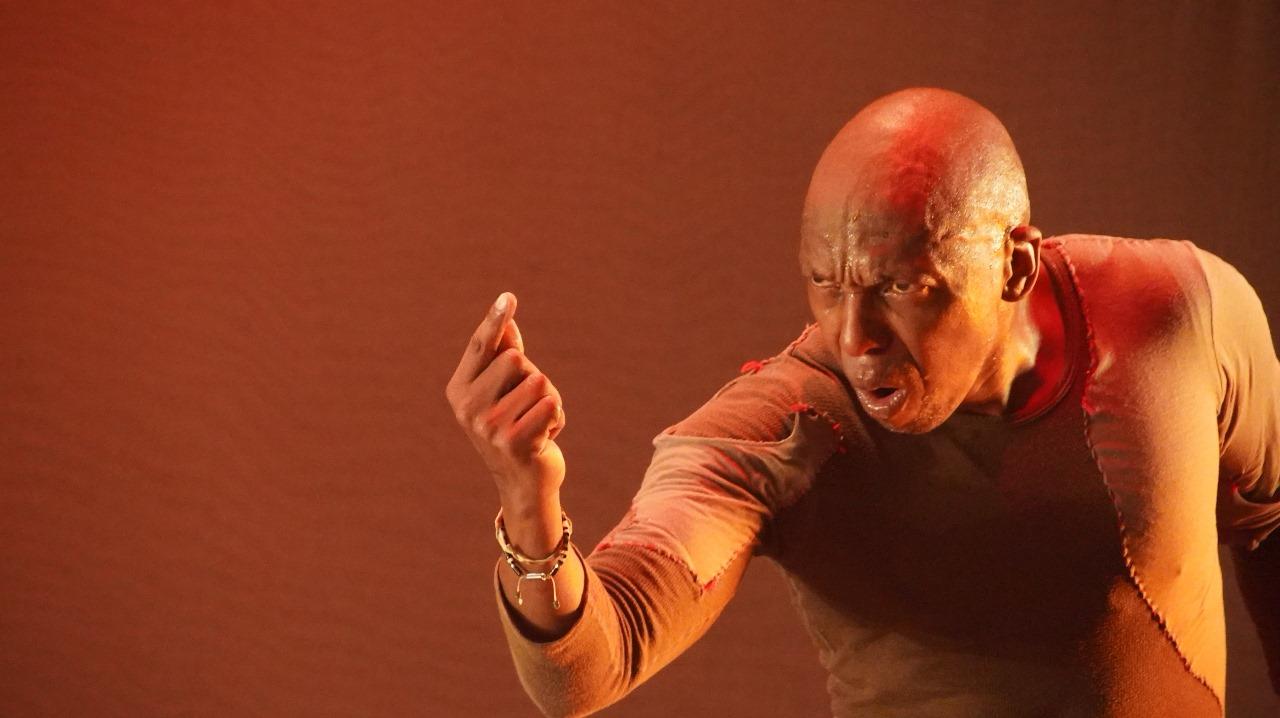
Choreographer and performer Vincent Sekwati Koko Mantsoe returns to the University of Johannesburg (UJ) as the 2026 Artist in Residence for dance. The residency comes after he premiered Desert Poems at the UJ Arts Centre in April 2025. Audiences can experience the first rendition of Mantsoe’s residency creation, Mpeyane’s Dream/Ipupo, in one performance only, on 25 October 2026 at 15:00 at the UJ Arts Centre, Keorapetse William Kgositsile Theatre.
Mpeyane’s Dream/Ipupo revisits more than three decades of his creative practice and reshapes it for the stage and for the lecture room. The production takes Mantsoe back to the beginning of his journey. Its central character is confused about who he was, and dreams his way towards his ancestors, his spirits, and his own path.
“This is a development process. There is nothing concrete yet,” says Mantsoe. “I am trying to shape it like a dream, to tap into different ideas and see how they come out physically and emotionally.”
The residency gives him room to refine and retune elements of earlier work rather than repeat them. For this piece he is also composing his own music and designing the set. music draws on isiXhosa sounds and ties the character’s dreaming to the spiritual world.
“The music links to the spirituality, because this is who I am and where I come from,” he says. “I come from a family of Sangomas. Without that, I would just be creating for the sake of creating.”
Mantsoe wants the new work to serve higher education as well as the stage. He sees it as a case study of how he has developed his practice, one that students can interpret and learn from. It extends his long-running investigation into teaching approaches derived from sangoma ritual practice.
He also wants to bring traditional and contemporary forms together with care. “These are sacred movements that I am using on stage and in rehearsal,” he says. “I have to treat them with respect, understanding where they come from and what the implications are.”
Above all, he hopes audiences leave changed. “My work is not light. I want to penetrate and go deeper into the core,” he says. “The ancestors are talking to me in different ways, and I portray that without guilt and without reservation. It goes beyond entertainment. People have to be moved by something higher than themselves.”
Mantsoe’s Artist in Residence performance will take place at the UJ Arts Centre, 25 October 2026 at the UJ Arts Centre at 3pm.
Tickets are available via Quicket at R150.
About Vincent Sekwati Koko Mantsoe
Vincent Sekwati Koko Mantsoe is a South African choreographer, dancer and teacher, born in Soweto in 1971. He was raised in a family of sangomas and played the drums at healing ceremonies alongside his grandmother, aunt and mother.
He taught himself to dance through youth clubs, music videos and street dancing. In 1990 he won a scholarship to Moving Into Dance Mophatong, the pioneering multiracial company founded by Sylvia Glasser. He served as its associate artistic director from 1997 to 2001 before forming his own company.
His Afro-fusion style draws on traditional African dance, contemporary and ballet technique, and Asian martial arts. His solos include Gula, Mpheyane, NTU and Skwatta. He has created work for Dance Theatre of Harlem, Skånes Dansteater in Sweden and ACE Dance and Music in the UK.
His awards include first prize at the Rencontres chorégraphiques de Bagnolet in 1996 and 1998 and the Prix du Peuple in Montreal in 1999.
About UJ Arts & Culture
UJ Arts & Culture, a division of the Faculty of Art, Design & Architecture (FADA) produces and presents world-class student and professional arts programmes aligned to the UJ vision of an international university of choice, anchored in Africa, dynamically shaping the future. A robust range of arts platforms are offered on all four UJ campuses for students, staff, alumni, and the general public to experience and engage with emerging and established Pan-African and international artists drawn from the full spectrum of the arts.
In addition to UJ Arts & Culture, FADA (www.uj.ac.za/fada) offers programmes in eight creative disciplines, in Art, Design and Architecture, as well as playing home to the NRF SARChI Chair in South African Art & Visual Culture, and the Visual Identities in Art & Design Research Centre. The Faculty has a strong focus on sustainability and relevance, and engages actively with the dynamism, creativity, and diversity of Johannesburg in imagining new approaches to art and design education.