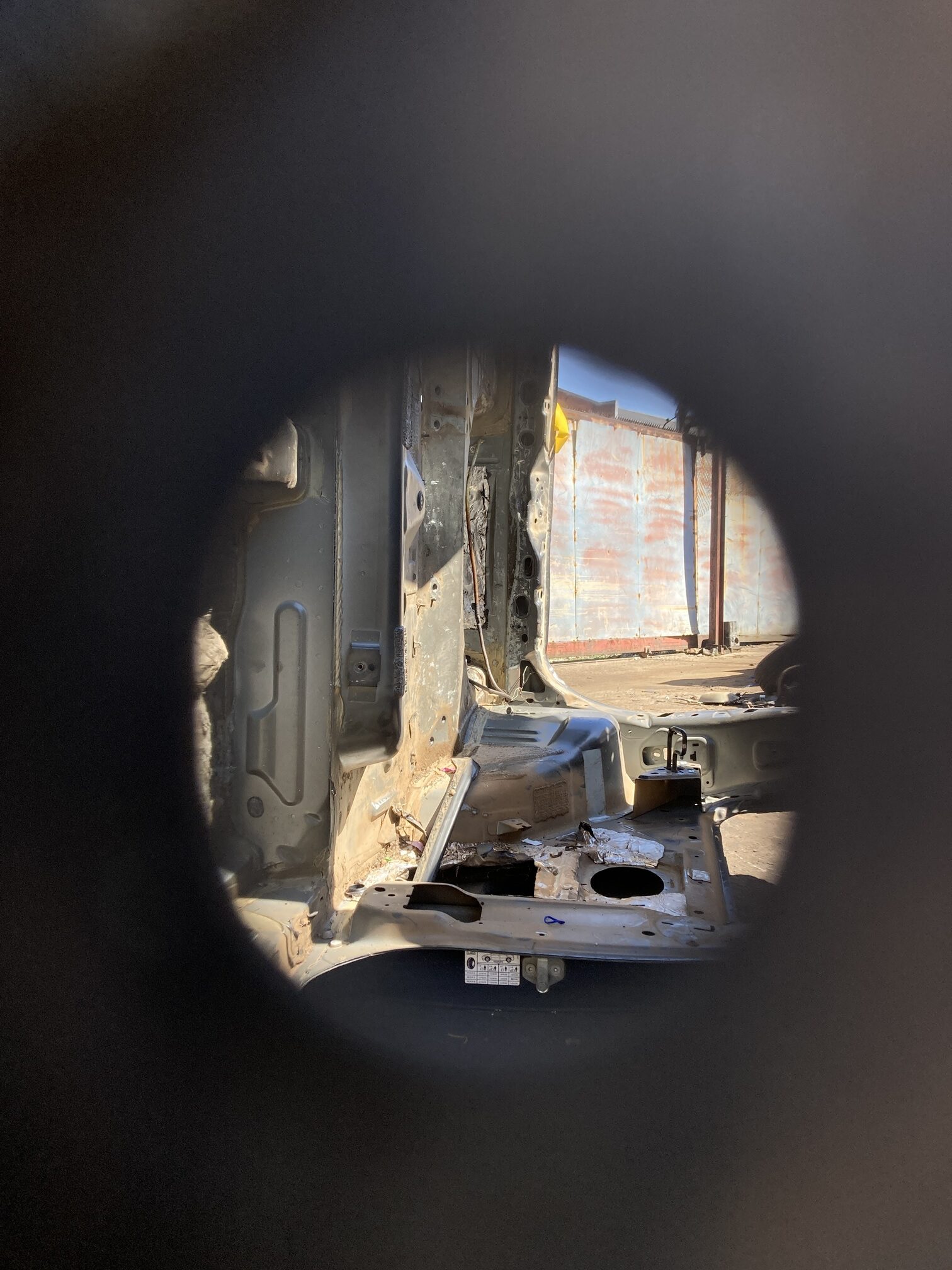
UJ Arts & Culture, a division of the University of Johannesburg’s Faculty of Art, Design and Architecture (FADA), presents The Hole World,
a solo exhibition by Noa Mori, UJ’s 2026 Artist-in-Residence hosted by the UJ Art Gallery. Curated by Simangaliso Sibiya and Adam Fertig, the exhibition runs from 28 November 2026 to 30 January 2027.
Sited within UJ’s Simulacrum Mining Facility, an artificial training mine complete with its own vertical shaft, stope, tunnels, refuge bay, and rail tracks, the exhibition asks how one prepares to go underground.
Following a report of a catalytic converter stolen from a car in Providence, Rhode Island, for the few grams of platinum, palladium, and rhodium inside, The Hole World traces the global paths of these metals between South Africa, the world’s leading producer of platinum, and the United States. In catalytic converters, platinum-group metals catalyse the conversion of toxic vehicle exhaust into less harmful emissions, helping a system built on cars appear compatible with environmental responsibility without addressing its underlying dependencies.
Over several years of fieldwork, Mori has followed these metals across the blurred lines between formal and informal economies, from disused mine shafts worked by informal miners to catalytic converter theft networks and the heights of international finance. Along the way, the metals become an invitation to take instruction from the savants of the underground: miners, geologists, scrappers, death doulas, earthworms, spirits, and ghosts.
Within the Simulacrum, Mori assembles a world full of holes: a messy forensic architecture of dust, feedback loops, hybrid bodies, suspended relics, and fragmented evidence. Here, holes are at once absences and openings, ways of seeing from another position and of sensing the relations gathered around what is missing.
The exhibition investigates not only the material and social life of these metals but also the conditions through which evidence becomes visible, relationships take shape, and different kinds of unknowability emerge. Some things are deliberately concealed; others are protected by a right to opacity; still others exceed the limits of perception or the capacity of any one person to comprehend the systems they inhabit.
Rather than simply explaining a supply chain, The Hole World makes the experience of trying to understand one feel fractured, embodied, and occasionally overwhelming. Approaching the desire to know as a descent, the exhibition asks what happens to us when we find ourselves already inside the systems we seek to understand and what forms of relation, responsibility, and solidarity might become possible along the way.
Exhibition Opening
Date: Saturday, 28 November 2026
Time: 11:00–14:00
Venue: Sibanye-Stillwater Mining Simulacrum, QK Building, UJ Doornfontein (entrance on Height St)
Click here to RSVP to the opening
The Hole World is installed inside the Sibanye-Stillwater Mining Simulacrum, a training mine with tunnels, rail tracks and uneven ground. Because the installation is experienced within this specialised environment, visitors can access the exhibition only during the opening and at scheduled viewing sessions. Please plan your visit around the published dates and times.
The Simulacrum is accessed via one flight of stairs and has no step-free access. Comfortable shoes are required, and personal protective equipment will be provided at the entrance.
Wednesday, 2 Dec 13:00 – 15:00
Thursday, 3 Dec 13:00 – 15:00
Saturday, 5 Dec 11:00 – 13:00
Saturday, 23 Jan 11:00 – 13:00
Saturday, 30 Jan 11:00 – 13:00
Click here to RSVP to the Public Programme
About Noa Mori
Noa Mori’s work reckons with what is too big to hold. Working across video, installation, cartography, sculpture, and writing, they trace the relations between earth (planetary and climatic forces) and world (the systems built to apprehend them: science, magic, capital, and myth). They are drawn to materials and ideas that can be followed, broken apart, and reassembled differently, revealing how we, too, might be remade. Mori is currently a Fulbright researcher and artist-in-residence at the University of Johannesburg.
About UJ Arts & Culture
UJ Arts & Culture, a division of the Faculty of Art, Design & Architecture (FADA) produces and presents world-class student and professional arts programmes aligned to the UJ vision of an international university of choice, anchored in Africa, dynamically shaping the future. A robust range of arts platforms are offered on all four UJ campuses for students, staff, alumni, and the general public to experience and engage with emerging and established Pan-African and international artists drawn from the full spectrum of the arts.
In addition to UJ Arts & Culture, FADA (www.uj.ac.za/fada) offers programmes in eight creative disciplines, in Art, Design and Architecture, as well as playing home to the NRF SARChI Chair in South African Art & Visual Culture, and the Visual Identities in Art & Design Research Centre. The Faculty has a strong focus on sustainability and relevance, and engages actively with the dynamism, creativity, and diversity of Johannesburg in imagining new approaches to art and design education.